
Carson City Directory Collections by Era
Historical directory research starts with a jurisdiction check. There is no verified long pre-incorporation Carson run, and a current parcel may be filed under a neighboring district or a regional title. The coverage map below separates likely directory sources from archival records that support an address trail without being alphabetical resident lists. Where inclusion is described as variable or promising, inspect the volume before claiming a Carson match.
| Collection | Years | Where Held | Access |
|---|---|---|---|
| Los Angeles area city and street directories | 1875 to 1987 | Los Angeles Public Library digitized collection | Free online; title coverage varies |
| Historic City and Business & Phone Directories | Titles from 1873 onward | LAPL ResCarta browser | Free browse and search |
| Los Angeles South Suburban criss-cross | 1972 to 1995 | Library of Congress inventory | Inspect exact volume boundaries |
| Los Angeles County South Central and South Coast | 1990 to 1992 | Library of Congress inventory | Verify Carson inclusion by title |
| Californiana directories and local histories | Nineteenth century onward; title-level run unpublished | LA County Library, Norwalk | Closed stacks; request staff assistance |
| Rancho San Pedro archival records | 1769 to 1972 | CSUDH Gerth Archives | Finding aid, boxes, and archive contact |
The years do not form one uninterrupted local series. Verified ResCarta examples include Los Angeles volumes from 1873, 1875, 1878, 1879 to 1880, 1881 to 1882, a telephone volume from 1882, a San Pedro and Terminal Island volume from 1902, and later street and reverse books. Those titles make a search possible, but they do not guarantee that every modern Carson street appears. Record the title, publisher, page range, and place label each time a volume is opened. Each volume should be logged by its own geographic note before a result is treated as local.
The LAPL digitized collection description confirms the broader Los Angeles area run, while the ResCarta directory browser is the useful entry point for checking a title before travel or a staff request. It keeps the search tied to a real volume instead of a vague claim that an old phone book exists.
Note: A listed title can cross county lines, so its cover and geographic note matter more than the word Carson in a catalog record.
Search Carson Directories Under Older Place Names
Carson incorporated in 1968, but the land and communities that make up the present city were recorded long before that municipal label. A family may therefore appear under Rancho San Pedro, Dominguez, Keystone, Compton, Gardena, Wilmington or San Pedro, South Suburban, South Central, or Los Angeles County. The right search term depends on the year and the publisher's geographic choice, not only on the current city boundary.
Start with a known street, tract, business, church, school, or family spelling and pair it with two place variants. If a name search is empty, try the regional title, then search the reverse section by street and house number. Preserve abbreviations and diacritics exactly as printed. A street name can also shift between a full word and a shortened form, so a single failed text search is weak evidence.
The CSUDH Rancho San Pedro digital collection gives historical context for a place-name search through photographs and documents tied to the rancho and surrounding South Bay communities.
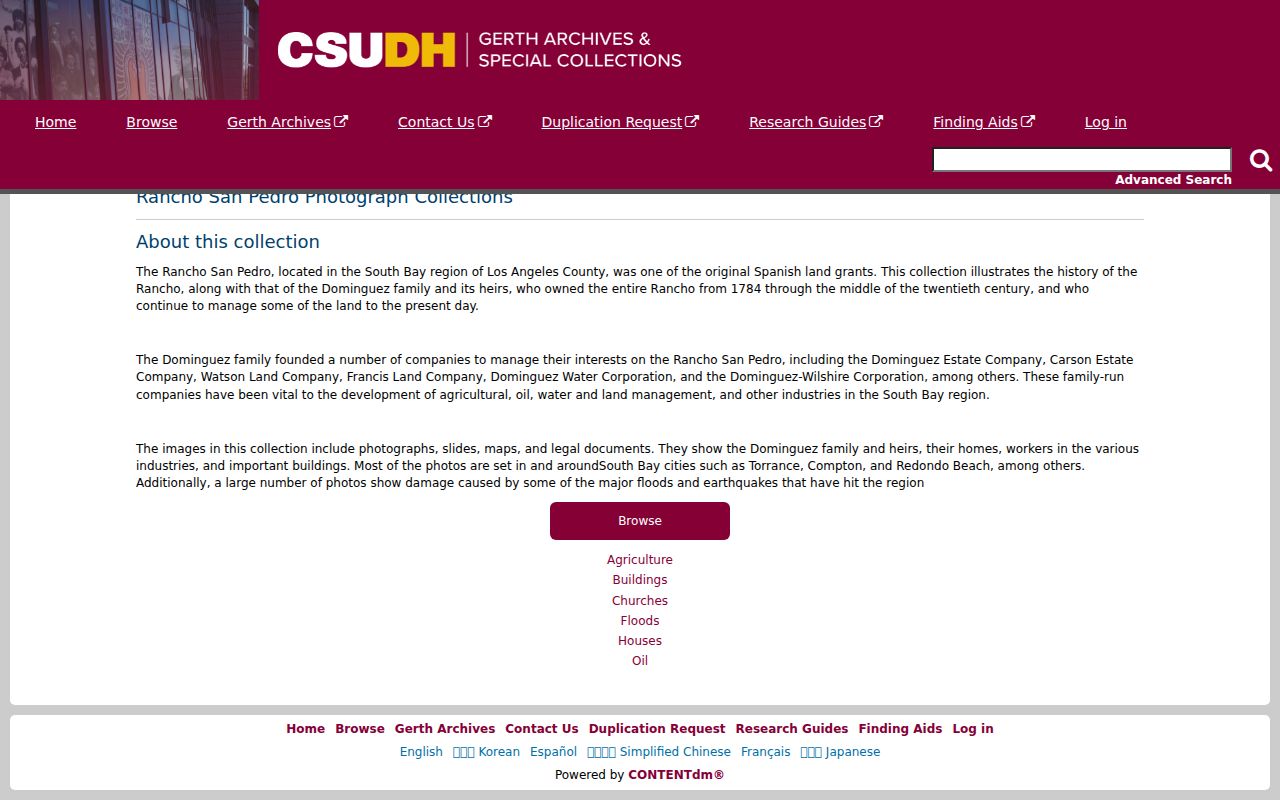
That collection is not a substitute for a directory index. Its value is the vocabulary it supplies: land, family-company, water, oil, farm-occupant, and community terms that can point toward the correct archive series when a modern Carson search term fails.
Use ResCarta Controls for Carson Directories
The ResCarta browser contains 184 titles and separate subcollections for historic city, business, telephone, and Los Angeles street-reverse directories. A title search works best when the control choices are treated as part of the evidence. A result in the wrong subcollection may describe a business or telephone book rather than a household listing, while a reverse volume may need an address format that differs from today's style.
| Control | Type | Use in a Carson search |
|---|---|---|
| Collection and subcollection | Selection control | Limit the search to historic city, business, phone, or street-reverse material. |
| Browse Titles | Action | Review title, publisher, and date before opening a scan. |
| Simple Search | Text search | Try a surname, street form, place label, or address fragment. |
| Sort | Menu | Order results by publication date or title to bracket a move. |
| Pagination | Result control | Move through neighboring titles when one search result misses a regional volume. |
The ResCarta collection browser shows how a free digital search can be narrowed before reading page images. LAPL's directory description also identifies reverse volumes in years such as 1906, 1927, and 1956 to 1987, though Carson inclusion varies by title.
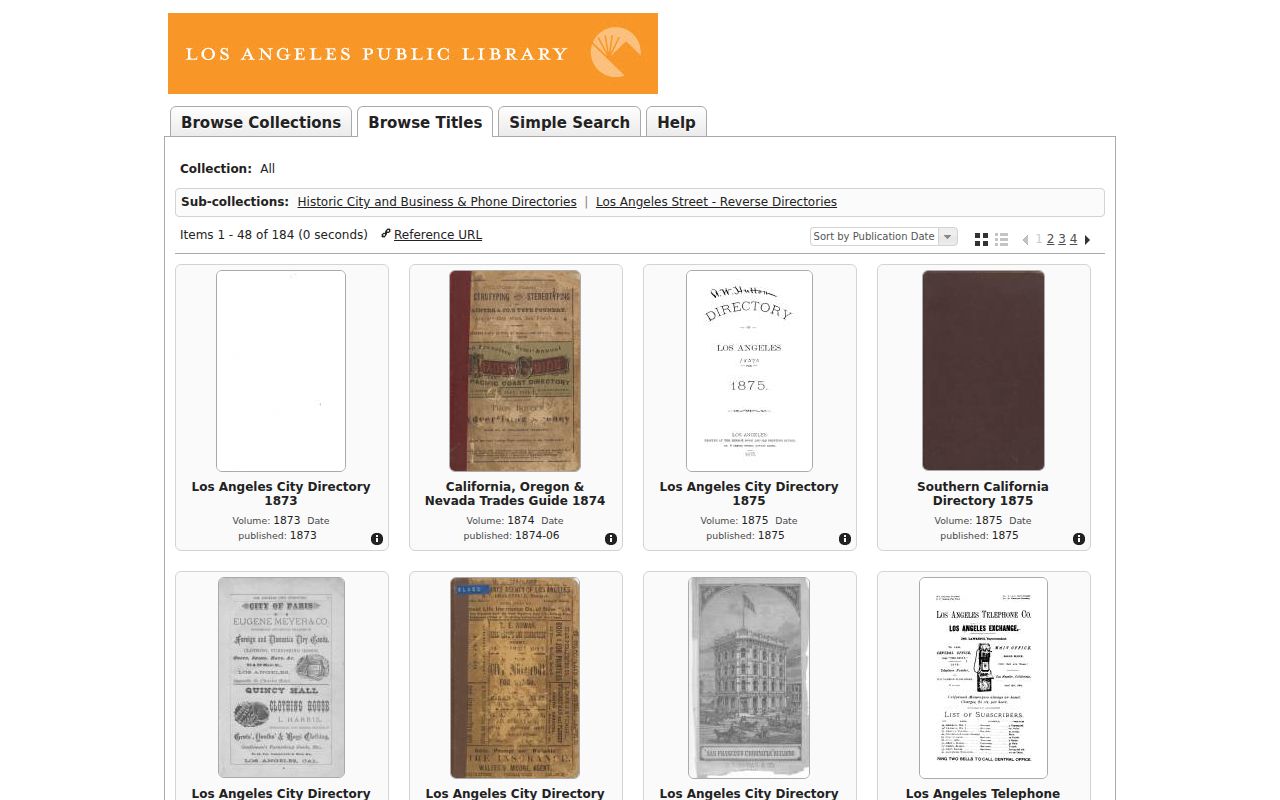
The browser is a finding tool, not a guarantee of OCR accuracy. Read the scan when a name, street, or place label matters, and save the volume title and page number so a later reader can repeat the search.
Norwalk's Closed Californiana Stacks
The LA County Library's Californiana Collection at Norwalk is a strong fallback when a digital search runs out of years. The collection holds more than 24,000 books and more than 200 periodical and newspaper titles, including nineteenth-century city directories, city and county histories, California census schedules from 1850 to 1910, Alta California material from 1849 to 1891, and the Los Angeles Star from 1851 to 1879. Closed stacks mean the request should name the place variant, title, and approximate year instead of asking for a broad search.
Carson Library, at 151 E Carson St., offers staff research help and can be reached at 310-830-0901. Its listed hours are Tuesday and Wednesday noon to 8, Thursday through Saturday 10 to 6. The Carson local-history page is useful for the city's historical setting, while the county local-history page describes the larger Californiana shelf.
Carson Library
Ask staff to check Carson, Dominguez, Keystone, Compton, South Bay, and South Suburban variants before choosing a year.
Norwalk Californiana
Request a title or collection-level search from the closed stacks at 12350 Imperial Hwy., Norwalk, rather than assuming open-shelf access.
The Californiana collection description explains why a local-history request can produce more than a directory page: census schedules, newspapers, and regional histories may confirm a move or explain a change in place name. A Carson request is stronger when it names the exact year and place variant.
Ask for the exact year and title first. Norwalk staff can then identify whether the material is a directory, a census schedule, a newspaper, or a local-history volume, each of which supports a different kind of family-history conclusion.
Note: Closed stacks require a title or year request; a broad request can return history material without the directory volume needed.
South Suburban and South Coast Reverse Volumes
Later Carson research often turns on reverse or criss-cross books rather than alphabetical volumes. The Library of Congress inventory identifies Los Angeles South Suburban material from 1972 to 1995 and Los Angeles County South Central or South Coast material from 1990 to 1992. These are promising regional sources for Carson, not a blanket promise that every volume covers every parcel. Check the title page, geographic notes, and street list before relying on a result.
A reverse book changes the order of the search. Instead of starting with a surname, move to the street, house number, listed occupant, business, or telephone entry. LAPL's broader collection includes reverse volumes in selected years from 1906 through 1987. Street abbreviations, numbered roads, and regional boundaries can shift from one publisher to the next, so record the book's own arrangement.
Criss-cross material can place a listed adult at an address, but it does not prove that every person in the household lived there. It also does not replace the deed chain, a census enumeration, or an archive record. Use it as the bridge between a name search and an address search, then test the same address in a nearby year.
Decoding a Carson City Directory Listing
A historical listing is easiest to read when each mark is kept in its period context. Common collection-confirmed fields include a surname and given name, a spouse in some years, an occupation or trade line, an address, and householder or residence abbreviations. Telephone and reverse volumes may add a number or place the street before the name. The format changes with the publisher, so the abbreviation key should be read before the first conclusion.
Research gap. No Carson-address sample page was verified in the captured collections. The conventions below are collection-level guidance, not a published individual example.
| Name line | Surname and given name, with a spouse or widow notation in some runs. |
|---|---|
| Address line | House number and street, often paired with an h householder or r residence mark. |
| Occupation or trade | A period description that can help separate two people with similar names. |
| Householder clue | A publisher's mark may distinguish the listed householder from a person who merely resides there. |
| Reverse entry | Street, number, occupant, business, or telephone information arranged for address-first searching. |
- Criss-cross directory
- A reverse directory arranged by street and house number so an address can lead to a listed name or business.
- Householder index
- The name-order route that identifies the primary listed household entry before the reverse pages are checked.
- Abbreviation key
- The publisher's legend for marks such as householder, residence, widow, business, and telephone notation.
Read the name page and the reverse page together when both exist. A name-order listing can show a spelling or family link, while the street-order listing can reveal whether the same address appears under a different abbreviation.
Note: An abbreviation key belongs to the volume that printed it; a mark borrowed from another publisher can reverse the meaning.
Trace Family History with Carson City Directories
For family history, choose one known name, address, and year, then move in small steps. The aim is to bracket arrival and departure, not to turn a single line into a complete household claim. A volume helps narrow the interval, while the federal census through 1950, deeds, probate, obituaries, and local archive material supply separate checks.
- Start with the first plausible volume and record the name, spelling, address, spouse notation, and page number exactly as printed.
- Check nearby years in the name-order section, then look at the reverse section for the same street and number.
- Pair a directory year before or after a census year with the released census household, keeping each source's date separate.
- Test a move with a deed, permit, newspaper notice, probate file, or archive finding aid rather than assuming a missing line means death.
- Close the trail with an obituary, cemetery record, or probate endpoint when the record is public and the identity is supported by more than one clue.
The 1950 census is the newest public federal census in 2026 under the 72-year release rule. It supplies relationships, ages, and birthplaces on one enumeration date. An annual volume adds an address and listed adult, but neither source proves every resident for every day of a year. When a historical listing needs a present-day identity check, use the official-record steps in the Carson resident lookup workflow rather than extending a directory inference beyond its evidence.
Rancho San Pedro Records Outlasted City Labels
The Rancho San Pedro Collection reaches from 1769 to 1972 and spans 301 boxes, about 155 linear feet, in twelve series. Its files include land, leases, farm occupants, water, oil, family-company, estate, and photographic material. Those are not city directories, yet they can explain why a person or parcel appears under a different place label before the modern Carson record system existed.
Roughly 110 linear feet of Rancho papers survived in a Dominguez Water Corporation boiler room before reaching CSUDH in the early 1970s. A March 27, 2026 finding-aid update reaccessed and consolidated Rancho and Gillingham research material, improving discovery of deeds, wills, petitions, maps, obituaries, and indexes. The smaller Gillingham Research Collection is four boxes, about 1.6 linear feet, and can be a focused orientation point before a larger box request.
The CSUDH Rancho San Pedro finding aid shows the series, date spans, extent, scope, access details, and preferred citation fields that should be recorded before contacting Gerth Archives.
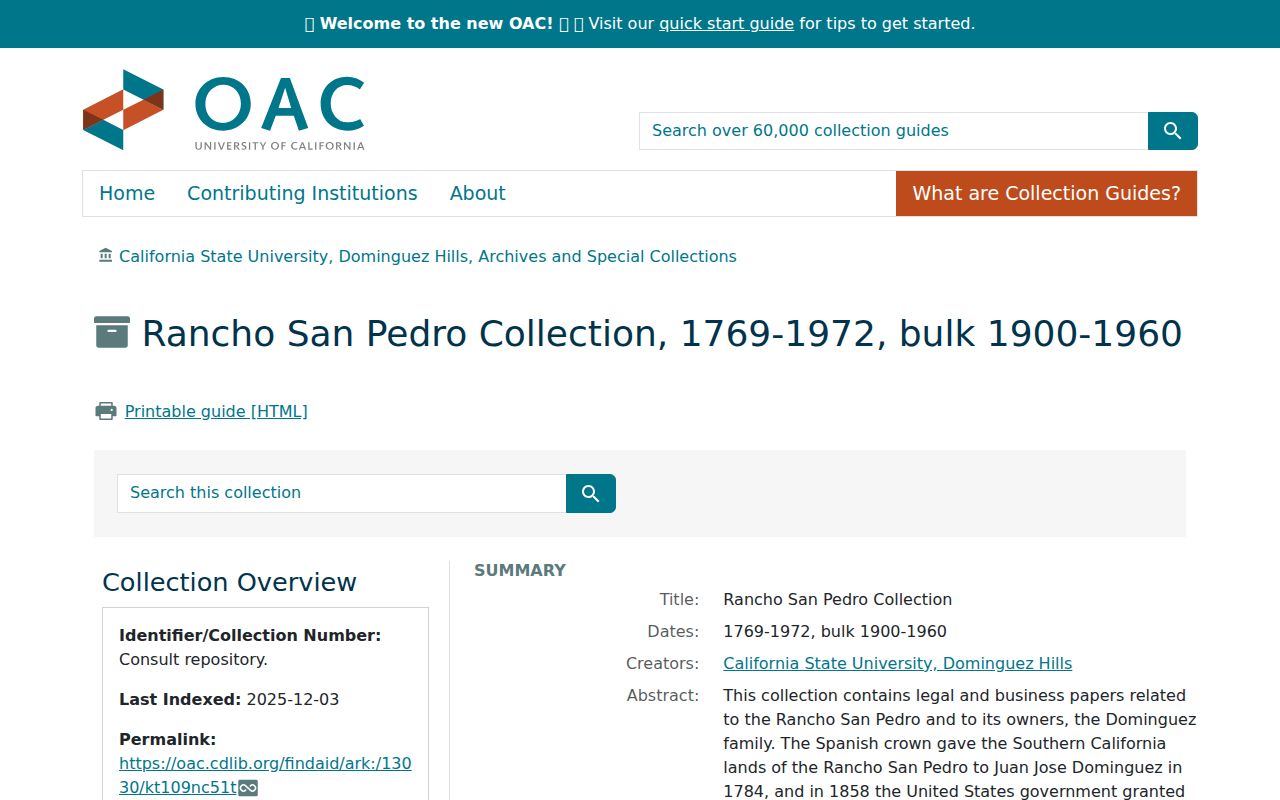
Gerth Archives is at 1000 E Victoria St., fifth floor, Carson; its contact is 310-243-3895 and archives@csudh.edu. A box and folder reference makes a historical request more useful than a broad request for every former Carson resident.
Note: A finding aid describes boxes and series, not automatic full-text access to every Rancho document.
Carson Community Archives Beyond Printed Volumes
Some Carson family and neighborhood trails live in photographs, letters, oral histories, meeting notes, and memorabilia rather than printed directories. The CSUDH South Bay digital collection adds community material with title, date, subject, location, and source metadata. These fields can preserve a place or organization name that helps a directory search return to the right decade.
The CSUDH South Bay digital collection is a useful companion when a directory page is thin or a local place name changed.
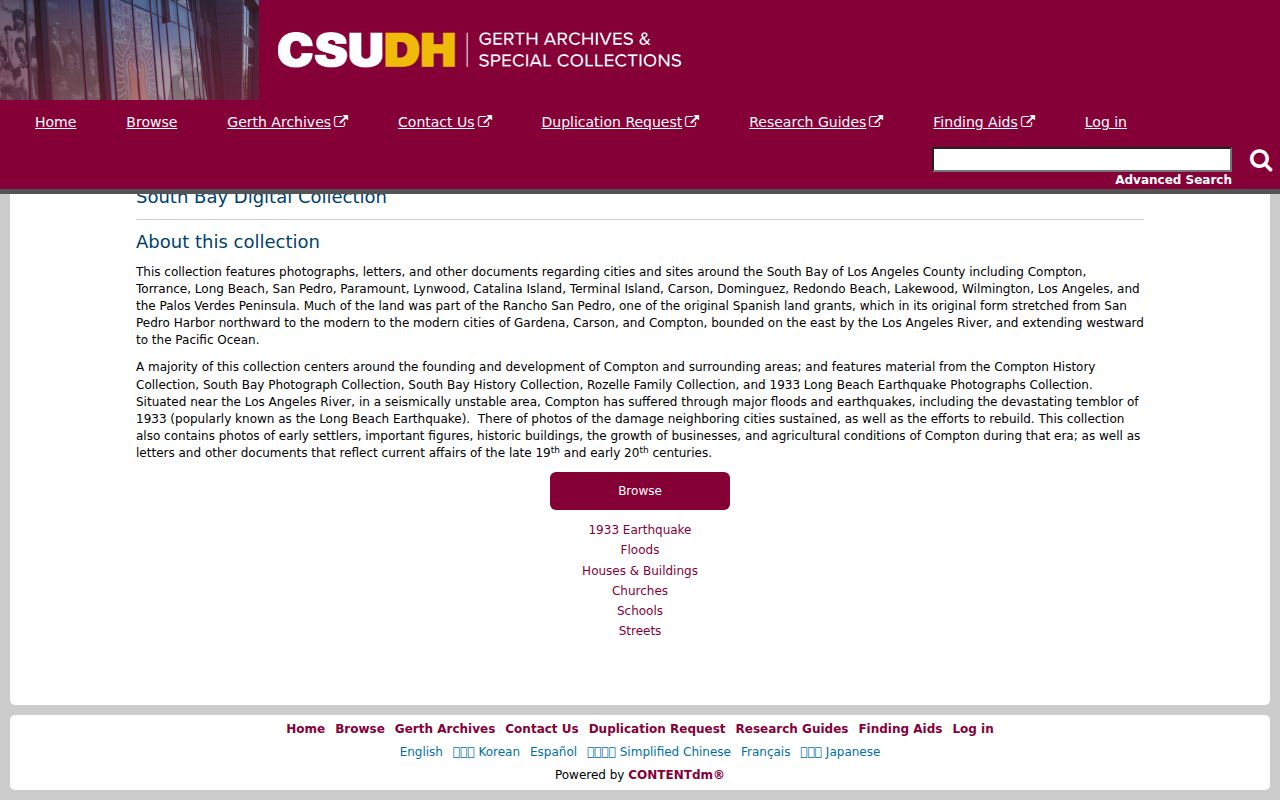
Its metadata helps separate a digitized object from a finding-aid description. A catalog entry may prove that a photograph or letter exists, while the archive contact confirms access and reproduction rules.
The Filipino American Digital Archives collection preserves Carson and South Bay oral histories, organization records, photographs, and memorabilia that can supply community vocabulary outside the usual directory shelf.
No authoritative public member directories were verified for Carson neighborhood groups, churches, a chamber, unions, veterans posts, or alumni. Treat archive collections as historical sources, not as permission to publish a current roster.
Carson City Directory Gaps Need Another Record
A missing line in a Carson volume can mean an unlisted person, a poor scan, an OCR error, a spelling change, a wrong place label, a skipped publication year, or a volume whose geographic boundary stopped nearby. It does not prove that an address was vacant or that a household had left. Search the original scan, then test a nearby year and a reverse title before closing the question.
Keep a small source log with the collection, title, publication year, page, search spelling, and place label. That record makes it clear whether the gap belongs to the source or to the search method. If the question is about a current parcel, follow the address-keyed chain in the Carson street directory. If it is about one living or historical person, compare the directory line with an official court, vital, deed, or archive source through the appropriate custodian.
Note: A directory can show a listed address in one year, but only a second record can establish whether the person owned, occupied, visited, or merely received mail there.