
Carson Previous Residents: Sources by Era
Research into Carson past occupants works best when each source is assigned the question it can actually answer. The county recorder can show a recorded transfer, but not every occupant. A directory can list an adult at an address, but not prove ownership. A census describes a household on one enumeration date, while permits show a project and its named participants. The table keeps those trails distinct while showing where they overlap.
| Source | Years It Covers | Where Held | What It Shows |
|---|---|---|---|
| Recorded real-property records | 1851 to present | LA County RR/CC, Norwalk | Legal transfers, parties, and descriptions |
| LAPL city and street directories | 1875 to 1987 collection; Carson inclusion varies | Los Angeles Public Library | Listed occupants or businesses by name and address |
| South Suburban criss-cross books | 1972 to 1995 | Library of Congress inventory | Address-to-listed-occupant clues |
| Federal census | Released through 1950 | NARA and library databases | Household on the census date |
| Carson permit and planning files | Civic Access since June 4, 2024; older coverage unverified | City departments | Projects, applicants, dates, and inspections |
| Rancho San Pedro papers | 1769 to 1972 | CSUDH Gerth Archives | Leases, farm occupants, land, and company relationships |
Start with the source that matches the time period. For a recent legal owner, bridge the address to an APN and then use the deed chain. For a listed household, move to a reverse directory and census pairing. For an early parcel history, search Rancho San Pedro and Dominguez variants. Past occupants often disappear from one source because a volume, place label, or record regime changed, not because the person or parcel vanished.
Note: A year span describes a source's holdings, not proof that every Carson street or household appears in every volume.
Start Carson Previous Residents with an APN
An address is the starting point, not the key used by every custodian. The Los Angeles County Assessor Portal accepts an address or a ten-digit Assessor Identification Number, and it also offers legal and map search modes. The county web result does not establish a broad owner-name search. Carson's municipal parcel feature service is a separate official source with owner and mailing fields, but GIS extracts can lag the county roll and should not be copied as a person sample.
Record the situs address, APN, legal description, municipality, and any available sale or assessment dates. Keep the owner mailing address in a separate field. Situs means the physical parcel; mailing means where a notice is sent. A mailing address can be a business, trust, service address, post office box, or older location, so it is a lead for the owner trail, not proof of who lived at the parcel.
| Address | Text or autocomplete mode; normalize number, direction, and street suffix. |
|---|---|
| Assessor ID Number | Ten-digit APN or AIN built from map book, page, and parcel portions. |
| Legal Search | Legal-description-oriented mode for a parcel description that may outlast a street label. |
| Map Search | Select a parcel and inspect nearby polygons when the address is uncertain. |
Carson's ArcGIS parcel layer exposes APN, tract, situs and mailing components, legal description, sale dates, zoning, building facts, exemptions, and parcel geometry. Use those fields to form a document request, then confirm the chain with the recorder's instrument. A homeowner exemption or matching mailing and situs address can support an owner-occupancy question, but it remains a dated indicator rather than a complete resident record.
Trace Carson Previous Residents Through Deeds
Los Angeles County's Registrar-Recorder/County Clerk holds recorded real-property material from 1851 to the present. The crucial access limit is easy to miss: the RR/CC does not offer a general public deed search by street address or APN. The name and year index is used in person, and a copy request becomes practical only after a document number, indexed party, recording year, and title have been identified. The county's real-estate records request page describes the copy channels after identification.
- Capture the current APN, legal description, and the best current owner lead from the assessor or parcel layer.
- Use a current acquisition date or party name to locate the purchase deed in the RR/CC alphabetical index.
- Read the deed's grantor and grantee roles, recording number, legal description, and date.
- Search the seller as grantee in an earlier year, then compare the legal description and APN rather than relying on a name alone.
- Repeat backward until the chain reaches the relevant period, moving from the newer floor to the historical floor at Norwalk.
- Order a plain or certified copy only after the instrument is identified, and keep the document number with the research log.
- Grantor
- The party conveying or giving an interest in the recorded instrument.
- Grantee
- The party receiving that interest; a prior seller may appear as a grantee in an earlier deed.
- Chain of title
- The linked sequence of recorded transfers for one legal parcel or interest.
- Legal description
- The lot, tract, or other land description that anchors a deed when a street address changes.
Deeds establish recorded legal interests, not the names of every person who occupied a parcel. A deed may also show a trust, company, or other entity. Match the legal description and dates, then use directories, census records, or permits for the household layer.
Note: The county's 1851 start describes recorded holdings, not an online address index; the name and year search remains an in-person step.
Carson Past Residents and Norwalk's Recorder Floors
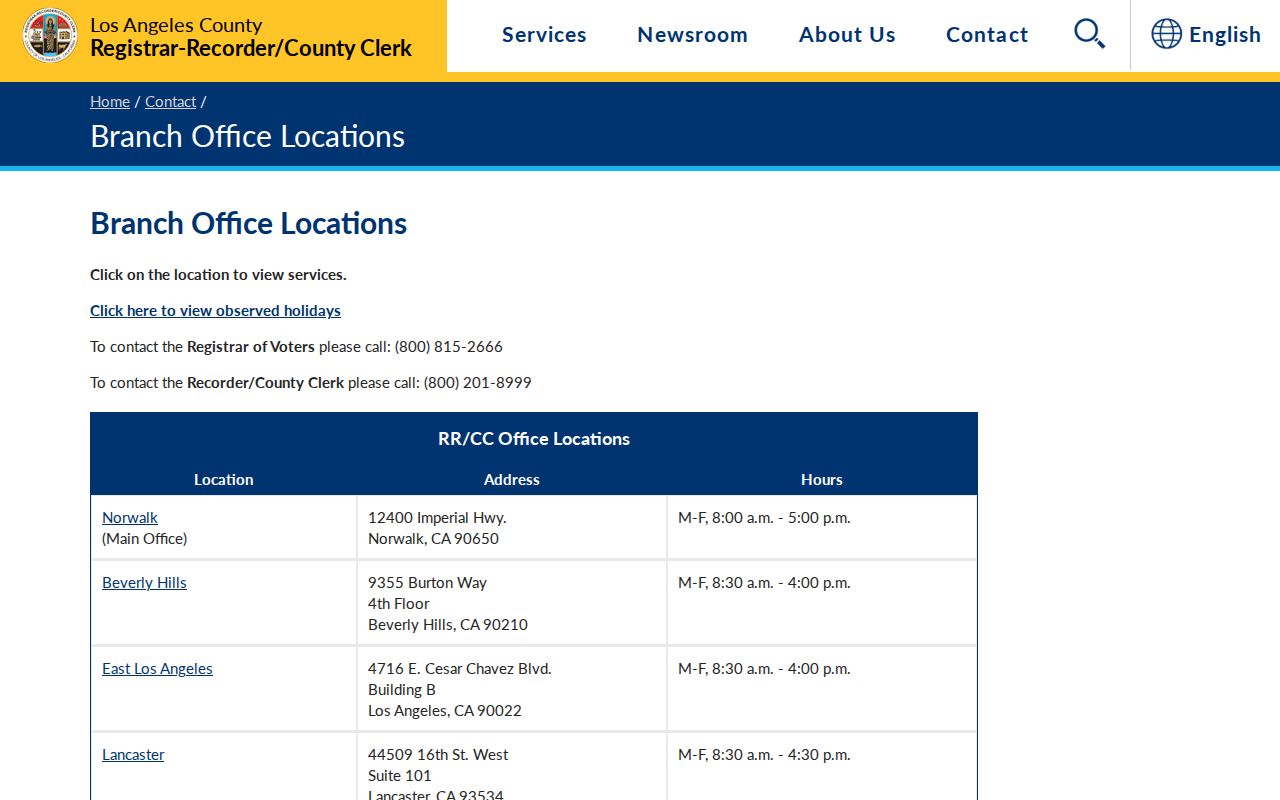
Norwalk is the key in-person stop for the long Carson deed trail. The RR/CC is at 12400 Imperial Highway. Real-property material from 1851 to 1957 is reviewed on the lower level, while 1958 to the present is on the second floor, Monday through Friday from 8 to 5. The RR/CC contact page lists 800-201-8999 option 3 and recorder@rrcc.lacounty.gov for real-estate routing. Staff can explain the index and copy process, but the county says telephone staff do not conduct the name and year search for a caller.
The LAX/Courthouse branch at 11701 S. La Cienega Blvd., sixth floor, is the closest listed full branch to Carson. It is open Monday through Friday from 8:30 to 4:30 and provides selected real-estate copies from 1982 to the present, along with current recording and vital services. The branch locator and the RR/CC contact page show the available counter channels. For a historical chain, Norwalk remains the stronger research location.
The RR/CC branch office locator shows the county's counter locations and service split for a Carson address-history search.
The county's copy channels include online, mail, fax, and in-person requests after the record is identified. A plain copy costs $5 for the first page and $3 for each additional page; a certified copy costs $6 for the first page and $3 for each additional page. The county says identified-document orders can take up to 20 working days and return complete instruments, not selected pages. A commercial ordering channel can submit an already identified document, but it is not a substitute for the county's index.
For a targeted request, use the recording year, indexed party, document number or book and page, title, and copy type. Deeds, releases, leases, liens, mortgages, and plats can describe different moments in a parcel's history. Keep each instrument separate so a recorded transfer is not mistaken for a move-in date.
Reverse Directories for Carson Previous Residents
Once a deed identifies an era, reverse directories can add the people who were listed at the address. LAPL's Los Angeles area directory collection runs from 1875 to 1987, while South Suburban criss-cross holdings reach from 1972 to 1995. South Central and South Coast volumes from 1990 to 1992 are promising regional sources, but the exact Carson boundary must be checked title by title.
Use the name-order pages for spelling and family clues, then switch to the reverse section for street, house number, listed occupant, business, or telephone information. The LAPL ResCarta browser exposes the digitized title and search controls, while the broader LAPL directory description explains the collection's year span. The historical volumes and their reading conventions are described in the Carson city directory collection record.
Directory notation matters. An h can mark a householder and an r a resident in some publishers, but the volume's own key controls. Street abbreviations and numbered roads can shift. Search Carson, Dominguez, Keystone, Compton, South Suburban, South Central, San Pedro, and Los Angeles County when the same parcel is absent under its modern name.
A reverse directory records a listed entry, not a complete household census. Treat a line as one piece of evidence and pair it with the deed, a released census, a newspaper, a probate file, or a city permit when the question depends on timing.
Note: Reverse-directory coverage changes by title, so a nearby volume can be more useful than a broader keyword search.
Carson Past Households: Directories, Census, Obituaries
The federal census supplies a household snapshot, while a directory can add annual movement between census dates. The 1950 census is the newest public federal census in 2026 under the 72-year release rule. It can show household relationships, ages, and birthplaces on the enumeration date, but it does not establish who stayed at the address throughout the year.
Address and year -> reverse directory listing -> nearby census household -> deed, obituary, probate, or permit check.
- Choose a directory year close to the census date and preserve the exact street form.
- Compare the household surname, ages, relationships, and address in the census record.
- Check the prior and next directory years for an arrival, departure, spelling change, or vacant listing.
- Use a deed, obituary, probate file, or permit to test a significant change instead of inferring a move from silence.
Carson's older geography makes the comparison harder. A household near the present city may be indexed under a regional or rancho label, and a directory's geographic cutoff may exclude a street that the census includes. Keep the enumeration district, directory title, and address wording in the same source log.
Carson Civic Access in a House History
Carson Civic Access launched on June 4, 2024 for Planning, Building and Safety, and Engineering. The portal supports applications, permits, plans, material submissions, payments, and inspections from one online workflow. A permit may name an owner, applicant, or contractor and show scope, valuation, dates, and inspection status. Those fields date work at a parcel; they do not prove that a named person lived there.
The Carson Civic Access portal's anonymous search fields, result fields, pagination, export behavior, and pre-2024 coverage were not verified. For a legacy file, contact Planning at 310-952-1761 or planning@carsonca.gov, Building and Safety at 310-952-1766 or building@carsonca.gov, or the City Clerk at 310-952-1720. The Clerk's public-record request form asks for a date, requester contact, and a description with a time period. It is for identifiable existing records, not a request for the city to compile every past resident.
Use a permit date as a checkpoint in the address trail. A roof, addition, plan set, or inspection can explain a physical change, but the responsible record may sit with a division, a contractor file, or a legacy system. Ask for the address, permit or case number if known, date span, division, and electronic format.
Note: A permit date anchors a project record, not a resident's arrival or departure at the Carson address.
Close a Carson Previous Residents Trail
Probate, obituaries, cemetery records, and death records can close a previous-resident trail when a directory or deed stops at a name. Los Angeles Superior Court holds probate cases and related filings; the Stanley Mosk Probate desk is listed at Room 429 and 213-830-0800. A known full name and death date make the search more focused. The LA County Library Californiana shelf holds historic newspapers, while LAPL databases include the Los Angeles Times Historical Archive from 1881 to 1996 and California Eagle from 1914 to 1964. Many obituaries were never published, so a missing notice is not proof that a person did not die or leave the area.
Vital records have their own access rules. LA County handles county birth, death, and marriage copies, while California's state vital-records custodian handles statewide records. Public marriage copies are different from confidential marriage records, which are restricted to spouses or a court order. A divorce certificate from the state is only an index-like filing record for its limited coverage; the decree belongs with Superior Court.
The LA County birth-record request page shows the county's online channel and copy process for a life-event check.
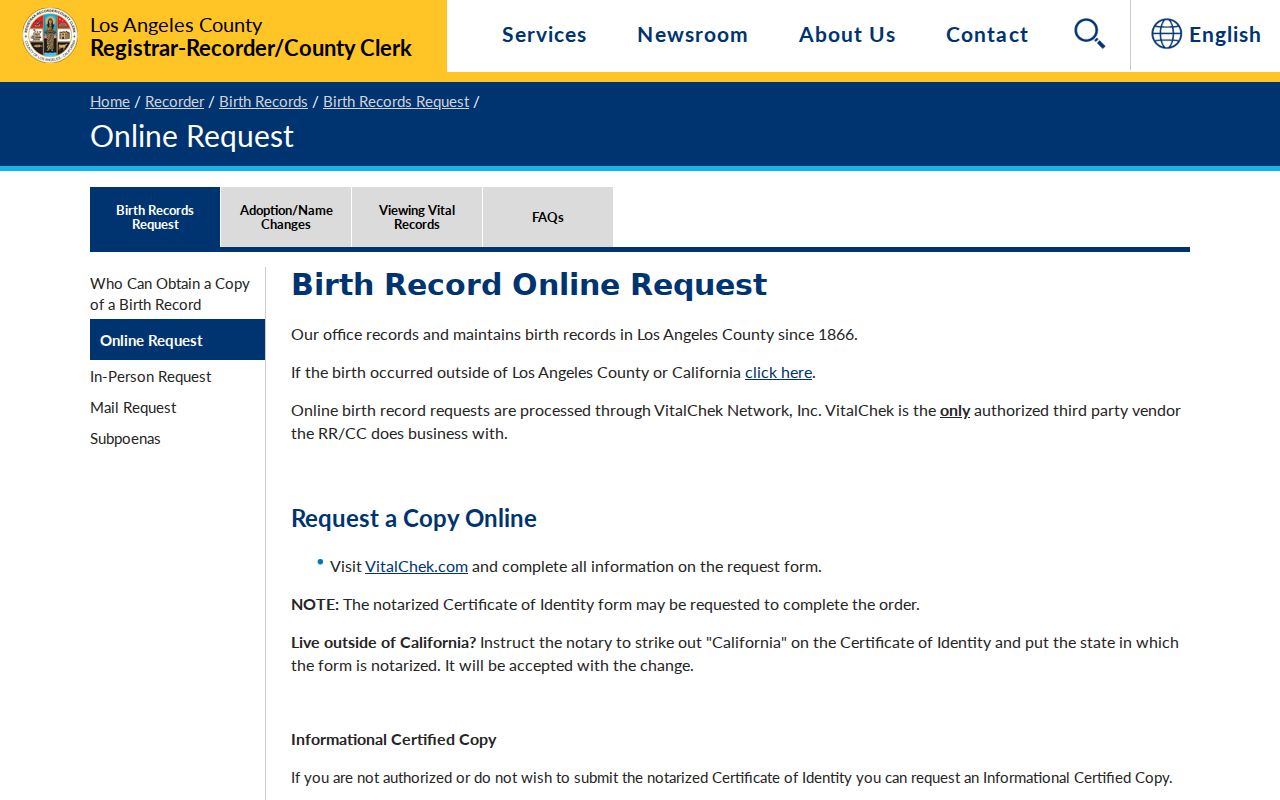
Online county orders use an authorized vendor and may add a handling fee. Counter and mail channels remain important for older records, and CDPH mail applications distinguish authorized copies from informational copies. An informational copy can confirm that a record exists while carrying a legend that it cannot establish identity. Keep a probate docket, obituary, or vital-copy result tied to the same name variants and date range.
Rancho Papers for Carson Past Residents
Carson past occupants can predate the city label by many decades. The Rancho San Pedro Collection at CSUDH reaches from 1769 to 1972, spans 301 boxes and about 155 linear feet, and includes leases, land, water, oil, family-company, and estate records. Those files can reveal a named relationship to land or a ranch operation when a printed directory did not yet cover the area.
Roughly 110 linear feet of the Rancho papers survived in a Dominguez Water Corporation boiler room before the material reached the university. The March 27, 2026 finding-aid update consolidated Rancho and Gillingham research material, including deeds, wills, petitions, maps, obituaries, and indexes. The Gillingham collection is smaller, at four boxes and about 1.6 linear feet, and may offer a focused starting point for a deed or probate question. The CSUDH Rancho San Pedro finding aid is the proper starting point for box and series research.
Carson incorporated in 1968. For earlier entries, search Rancho San Pedro, Dominguez, Keystone, Compton, South Suburban, South Central, San Pedro, and Los Angeles County as separate historical labels. No verified Carson-wide street-renumbering year or Sanborn sheet chronology was located, so an exact old-to-new address conversion needs archive or counter confirmation.
Limits on a Carson Previous Residents Search
A previous-residents search can establish that an owner held a recorded interest or that a directory listed a person at an address. It cannot turn a parcel into a full household roll. Owners may be absentee, a mailing address may be elsewhere, directories may omit people, and a census records only one date. Apartments, condominiums, mobile-home communities, parcels with several units, and industrial sites make a one-parcel-to-one-household assumption especially weak.
Some trails stop for legal reasons. The voter status tools are authenticated self-lookups, and voter-file products require a permitted purpose. Safe at Home supplies a substitute address and confidential voter registration for eligible survivors. Juvenile, adoption, sealed, confidential, and other protected records do not become open because an address is known. A missing field should lead to a lawful alternative source, not an inference about the hidden person.
Lawful house history. Carson previous-residents research is appropriate for family history, estate work, and personal house history. Do not use a record to stalk, harass, threaten, or track a living person.
Keep the research log conservative: source, custodian, title, date, page or document number, exact spelling, and what the record actually says. A deed is a legal transfer, a directory is a listing, a census is an enumeration, and a permit is a project record. Those distinctions preserve the value of a Carson address-history search without overstating what the public record can show.
Note: When an address trail stops, check the custodian, historical place name, and record type before deciding that a previous resident cannot be found.